
The Norms, Facts and Values Method
Claes MARTINSON
Professor in private law, exc / Professeur de droit privé, exc, Holder of theTorsten Pettersson Chair in Maritime and Transport Law, School of Business, Economics and Law, University of Gothenburg, (Sweden/Suède)
Résumé
Cet article explique le droit comme un ensemble de normes, de faits et de valeurs. Il illustre comment les juristes utilisent les faits et les valeurs de manière consciente et inconsciente, au point que leur comportement crée une réalité créée par les juristes. L’essentiel est cependant l’esquisse d’une méthode d’analyse juridique, tant dans la recherche que dans la pratique. Il s’agit d’une méthode qui peut également être utilisée pour construire un raisonnement juridique et pour la recherche interdisciplinaire.
Mots-clés
Recherche juridique – normes – faits – valeurs
Abstract
This paper explains law as a composite of norms, facts and values. It illustrates how lawyers use facts and values both consciously and subconsciously, even to the extent that their behaviour creates a lawyer created reality. The main point is however the outline of a method for legal analysis in both legal research and practice. It is a method that can be used also for constructing legal reasoning and for interdisciplinary research.
Keywords
Legal research – norms – facts – values
I. Why ?
What I present in this article is based on a theory of law that is rather basic, but at the same time so fundamental that it can be used in many ways, and in a lot of legal contexts. It is a theory that is rather easy to turn into different methods; methods that can be used for several different purposes.
To support my claim that I present something rather easy to turn into practice use, I can declare that I have for some years tested the theory and different ways to use it. I have used this understanding, and different variations of it, in several legal studies and research projects. My confidence in the theory is also an effect of pedagogical efforts. It might be an unusual choice to tell readers of a research paper in law about this, but I have used the theory in the teaching of quite some students over the years, and counting that several of my colleagues have done the same, it becomes more than 4000 students that has encountered the theory. A common reaction from students has been that they feel empowered by the understanding. As a teacher this is such a satisfying reaction to get from students that it is a relevant fact to mention. From what I have seen I am confident to believe that the same possible benefits can be reproduced also for others.
The main point I present is that some rather useful methods can be created on the base of the theory. To show this I here outline one of these methods. The method I outline is a method for legal analysis in both legal research and practice. I also outline how this method can be turned into a constructive tool that is useful for designing legal reasoning. With this method the lawyer in general can do relatively thorough analyses of legal argumentations and construct solutions to difficult questions of law. In the article I describe that the legal researcher might in addition find possibilities when it comes to what questions his or her research will concern. I also describe that the perspective on legal research can be broadened internally within the lawyer community, as well as externally towards other researchers and the public, to the benefit of the general understanding of law.
Since the claims stated might seem rather extensive, and what I present may be perceived in very different ways, it might be relevant to point out that my intention is just to offer the reader whatever the reader gets out of the text. I do not have the ambition to be understood on such a level that the reader needs to know for example what my underlying conception of law is, what I mean with the way I use the concept of “theory” apart from what follows from my text, or how I would translate what I present to the different areas of law that the different readers are knowledgeable in. In this article I have given priority to the level of overview.
II. The theory
The theory is that we can understand law as a composite of norms, facts, and values. To communicate this conception, it is useful to use an illustration. In this illustration law is pictured as a triangle. The corners of the triangle are three different aspects of law1C. Martinson, Kreditsäkerhet i fakturafordringar [traduction: Garantie de crédit dans les factures à recevoir], Iustus 2002. Compare J. Pöyhönen (Karhu), Regler och principer i rätten [traduction: Règles et principes de droit], lecture, Majvik, Finland, 21 maj 1996, where Pöyhönen spoke about three perspectives that a researcher can use when looking at the law; norms, facts and values. Compare Jaap HAGE, Facts, values and norms, in S. Taekema, B. van Klink and W. De Been (eds.), Facts and Norms in Law, Interdisciplinary Reflections on Legal Method, Edward Elgar Publishing, 2016. Compare the use of the same terminology in philosophy by P. Railton, “Facts, Values, and Norms”, in Essays toward a Morality of Consequence, Cambridge Studies in Philosophy, Cambridge University Press, 2003..

With this theory, law consists of norms, but these norms can not be understood, nor used, without an understanding of facts and values. The norms themselves can be seen as frozen values concerning a context of facts. In other words, law is not only norms, since the norms needs to be understood in the context of the facts and the values that are in our perception, whether we make these parts evident to ourselves or not2There are similar theories in which law is seen as a composite phenomenon. In one of them law is seen to have three dimensions; one normative, a moral and a societal-factual. Another highlights law as an ideology and mediator of reality, and as such a coherent system of ideas which contain – reality statements, values, and norms. There are also examples of conceptions of the law which, without using the terminology, nevertheless express similar things content. The law is then described, for example, as; legal material that must be interpreted – with partly consideration of the effects and appropriateness of rules – and partly moral considerations. Yet another explains legal interpretation with regards to rational viewpoints and notions of plausibility. There are also examples of recommendations about using several perspectives but where the perspectives are assigned other epithets. Therefore, it is possible to elucidate legal problems and legal relations to non-legal phenomena from three views – a historical, a sociological, and a value point of view. For references see: H. Tolonen, Rättssystemet som ett system för institutioner och rättsförhållanden (rättigheter) [traduction: Le système juridique en tant que système d’institutions et de relations juridiques (droits)], JFT (Tidskrift utgiven av juridiska föreningen i Finland), 1993, p.45-46. D. Töllborg, Personalkontroll, [traduction: Contrôle du personnel] Symposion, Stockholm/Lund, 1986, p.37. G. Skogh and J.-E. Lane, Äganderätten i Sverige, En lärobok i rättsekonomi [traduction: Le droit de la propriété en Suède. Un manuel d’économie juridique], 2nd ed, SNS Förlag, Stockholm, 2000, p.19. K. Grönfors , Ändamål och funktion [traduction: Objectif et fonction], JT (Juridisk Tidskrift), 1999-2000, p.523-537, at p.537. J. Dalberg-Larsen, Retsvidenskapen som samfundsvidenskab [traduction: Le droit en tant que science sociale], Juristførbundets forlag, København, 1977 p.536. See also S. F. Bailey, The Common Good in Common Goods, The Decommodification of Fundamental Resources through Law, University of Gothenburg, 2020, p.150-240..
What this theory claims, is that this relationship, between norms, facts, and values, is an inevitable part of law. We need the facts and values to make up the relevance and significance of the norms we deal with as lawyers3Compare the conception that we, without values have no interest or sense of relevance or significance, L. Wirth “Letter to Gunnar Myrdal 29 September 1939”, in G. Myrdal, Objectivity in social research, Phanteon books, 1969. Compare W. De Been , S. Taekema and B. van Klink, “Introduction: Facts, norms and interdisciplinary research”, in S. Taekema aekema, B. van Klink and W. De Been (eds.), Facts and Norms in Law, Interdisciplinary Reflections on Legal Method, Edward Elgar Publishing, 2016, p.3-4, 18. In the same anthology G. Samuel, Imitation of life: Resonances between law and fact and fact and law, p.55.. The facts are necessary for the context and consequences, and the values for the assessment involved in every legal thought process4Compare S. Taekema, “Theoretical and Normative Frameworks for Legal Research: Putting Theory into Practice”, Law and Method, February, 2018, p.1-17, on p.13.. These processes do in turn lead to normative decisions. It is, with this theory, a matter of a symbiotic relationship between the three concepts. Consequently, since this symbiosis is there, the understanding of law can gain from expressing it and making it evident, rather than to consider these aspects on a subconscious level5Note that from what I have described follows that, facts, as I use the concept, are not the circumstances (facts) of a specific case. Compare, for example, U. De Vries, “Kuhn and legal research – A reflexive paradigmatic view on legal research”, Law and Method, (3), 2013, p.7-25, p.17..
There are of course many ways to deal with the symbiosis. I prescribe no specific way of doing this. Rather, I encourage everyone to think for themselves.
I encourage the readers to develop something of use for the context they have at hand. What I can do, in this article, is however to show some of the ways that the theory can be used to construct a few different methods. (Alternatively, what I describe can be seen as one single method with several different uses.)
III. A basic method
One way of dealing with the symbiotic relationship between norms, facts and values is to analyse legal argumentation by looking for the different aspects of a specific argumentation. This can be done by assessing each statement in the text as either a normative argument, a fact-based argument, or a value-based argument. Note that it is not necessary to think in terms of a fixed standard for the assessments6It is indeed possible to go rather deep into the understanding of what characterizes an argument as a norm, a fact, or a value. Already on the surface it becomes rather clear that it is a matter of a grade difference between them, rather than of difference of kind. The argument expressed as freedom of contract, do for example have a normative side, as well as a fact-based and value-based side.. The method can be used relatively. An assessment can be made in relation to the other argument used in the argumentation at hand, and in relation to what is characteristic for the concerned area of law. Since the primary point is to analyse for the benefit of your own understanding the assessments can also be made subjectively.
The assessments are the first step. A second step might be to get an overview by collecting the different arguments in the three separate categories. Each of these two steps will give the analyst an idea of how the argumentation is constructed. For some purposes already a reading of the text from the perspective of the theory can be enough to reach a higher level of understanding of the argumentation.
Through the assessment process important characteristics of the argumentation can become evident7As follows from the above, it is rather the characteristics of the text – such as the reader perceives it – that becomes evident. This does however not mean that the analyses do not say anything at all about the characteristics of the text. When the reader communicates his or her analyses others may of course agree, and thereby confirm the characterisation.. It can, for example, become evident that the argumentation is in its decisive parts built on assumptions of facts, rather than on normative arguments. This possible outcome is something I will illustrate in the next section.
IV. The example
Law is most often communicated in the form of text. It is given the form of written legal argumentation. The author of the text often argues that the law is what the author believes it to be. Some other times the author of the text argues that the law should be in a way that the author wants it to be. Depending on the lawyer-role that the author has, and depending on the context, the texts are normative to different extent. It is however often possible to detect that the lawyer has used assumptions on what the reality is. These assumptions are what the lawyer wants the reader to conceive as aspects of the reality. In other words, they are aspects that the lawyer perceives as facts. They are often presented as if they are not even arguments, but simply the reality. Therefore, they tend to not surprise the reader. It is also often possible to detect that the lawyer uses values as arguments. These values seldom surprise the reader since there are a number of values that lawyers have learnt to use, such as protection of weaker parties, foreseeability, and fairness.
When it comes to the process of detecting how a specific legal argumentation has been composed, it is easier to do this in some texts than in others. My choice in this article is to use a rather evident example. This brings the advantage that it is easy for the reader to follow. The disadvantage is that the example concerns a rather specific context of private law and the law of obligations, which may be of little interest to some readers. I do however believe that the readers, irrespective of their interest and specialisation, will be able to transpose the example to an example from their own context. To simplify this transposition, I will keep the example as general as possible. This includes that I will not here mention the jurisdiction concerned, nor who the author of the text is. What I see relevant to clarify is however that it is a text written by a prominent lawyer, in a book, a classical monography over an area of law.
The argumentation of the lawyer concerns a question of law. In its basic form this question concerns to whom a debtor should pay. This is a simple question of a basic legal obligation, but the context is a bit complex since it concerns five parties. The Seller, who on the one side has a Customer that the Seller has given credit, and on the other side a Financier, from whom the Seller got a credit by using his claim on the Customer. The fourth party is the general Creditors of the Seller, and the fifth party is the general Creditors of the Financier. In the typical set-up of the relationships described, the Sellers claim towards the Customer is 100 of one kind of currency, and the Financier’s credit to the Seller is 80. This is so because the Financier typically likes to have a safety margin. The set-up is also that the parties have agreed that the Customer should pay to the Financier. They have done so because the other parties, and especially the Seller, trust that the Financier will pay any excess amount received from the Customer to the Seller.
The set-up will work fine as long as there is trust between the Seller and the Financier. Without trust the Seller might think that the Financier will put the excess amount in danger in different ways. This includes the risk that the Financier becomes insolvent and that the amount becomes a common good for the Financiers general creditors.
The question of law is to whom the Customer should pay the excess amount. It is evident that the Seller wants the Customer to divide the payment. The Financier do however not want this since it will possibly lead to that the safety margin can be jeopardised in all set-ups of this kind. This would invoke costs to these kinds of set-ups at-all-times. These costs will occur since the Customer lacks reliable information. The Customer needs to get the same information about the amount from both the Seller and the Financier and, considering the lack of trust, this is unlikely to be the case. Also, the amount can depend on what day the payment is made, taking into account interest rates and other contract terms. Therefore, the Financier wants the Customer to pay the whole amount to him. If also the interest of the Customer is considered, it becomes evident that a Customer does not want trouble with investigating to whom and how much he should pay. Nor does the Customer want to stand the risk of having to pay more than one time, because of failure to pay with liberating effect. There are also some more problems in the relationships, especially if there are not only one Customer, as in the common use of factoring. Those cases, with multiple Customers, are however unnecessary to look into in the context of this article.
V. The argumentation
As mentioned, a prominent lawyer identified the described question of law and wrote about it. He pointed out that the question was an unclear question of law, in the jurisdiction concerned. Thereafter he expressed his first argument. His first argument concerned the risks.
“In my opinion, H has underestimated the risks for the seller and thus also the risks for the customer.”
With this argument the lawyer, who I now call W, claims that someone else has underestimated these risks. Someone else is in this case another prominent lawyer, H, who had already earlier identified the same question of law and written about his conclusions in another book. H’s conclusion was that, as a rule, the Customer should pay the whole debt to the Financier, unless the Seller applied to the court and gets an official injunction. W’s conclusion was another, namely that the Seller should not have to go to court. According to W the Seller should, by just contacting the Customer, be able to oblige the Customer to divide the payment in two, one part to the Financier and the other part, the excess amount, to the Seller.
There are some interesting aspects of what I have now mentioned. The central aspect is that there are two lawyers dealing with the same question of law, and they both use risk as an argument. Risk can here be regarded to be an argument of fact. Both lawyers have made assumptions on the level of risk, and both have come to conclusions that are influenced by these assumptions.
They have also come to different conclusions. After going through all the other arguments made by the two, it seems that assumption of the risks is a somewhat decisive argument. It seems to be crucial when understanding why they came to different conclusions. To understand this can be very relevant. A reader who tries to deal with legal issues in the specific context will be able to do a better job if he or she identifies why the conclusions differ.
When we, as readers try to understand how the argumentations lead to different conclusions, it seems relevant to understand how the two authors estimated the risks involved. By finding out what the estimations are and how they did their estimations, the reader might be able to assess if one of them made a better estimate than the other. When we do that in this case, we do however notice that neither W, nor H, expressed anything quantifying the risks. As readers we do not know what they assume that the level of the risk is. Neither do we see any support for the assessments that the lawyers make. Interestingly, the assessment that W makes seems to be based on the fact that H comes to another conclusion than W wants to end up with. W does not think H has made an assessment of the risks that is as good as W’s own assessment, although W himself does not make any attempt to verify his own assumptions.
What we see as readers might, in formal logical terms, appear to be an equation where everything is the same, including the unknown factor X. The reason the conclusions differ is that H says the weight of X decides the conclusion in one way, and W says the weight of X decides the conclusion in the other way. None of them do however mention anything else about how they see X. The argumentations of the two lawyers are however more complex than this. This is so since legal argumentation on unclear questions of law generally is too complex to be captured in just formal logic.
The exercise of identifying the assumption of risk as decisive can nevertheless be useful. For someone who wants to solve, or decide, the question of law, the revelation that risk is decisive in the argumentations, is useful. It is useful when assessing how to handle the two normative argumentations in the process of reaching an own conclusion. When the goal is this, to reach a conclusion on the question of law, it also becomes evident that it could be relevant to make an investigation of the facts, in some way. Since the facts is said to be of somewhat decisive importance, evidence of what the facts are, seem very relevant. In principle, it seems possible to use such facts to decide the issue. If we, for example can get some information on the frequency when the phenomenon occurs, that might say a lot concerning the consequences, and of the possible costs with one or the other solution. Also, size of claims, known number of cases of distrust, etc, could be investigated. For a researcher in law this opens for reflections on how a more reliable assumption could be made, and in the end a more relevant conclusion.
VI. The further analysis
As described it can be useful to identify that facts seems to have been given a role that is of some weight in a specific argumentation. The method can however also be used for further analyses. In the example at hand the method can give the user a picture of the build-up of the argumentation. This can be useful in several different ways. Looking further into the argumentation of the example it becomes clear that the argumentation of W consists of arguments with different background.
The part of the text referred to reads like this:
“In my opinion, H has underestimated the risks for the seller and thus also the risks for the customer. On the other hand, he seems to have overestimated the importance of uncertainty about the financier’s principal claim, and this uncertainty’s likeliness to cause inconvenience. As he himself has pointed out, it is generally banks, that act as financiers. But even if some inconveniences of e.g. depositions in disputed cases may occasionally arise, they seem to weigh lightly compared to the importance of protecting the seller’s right to the excess part and the position of the customer, as far as this possible with the help of the promissory notes act.The somewhat frivolous attitude that have characterized the statements in the literature can be explained by a tradition that originates from a time when neither the legislation on deposit nor the legislation on promissory notes existed. It seems one should better use this legislation than what has happened so far. Particular attention should be paid to the increased opportunities for securing secondary pledging that has come with the promissory notes act and its rules on giving notice to the debtor. Also, the widespread use of secondary pledge should be taken into account8As mentioned, I see a point in not revealing who the author is, and therefore I give no reference. For those who like to know I will of course reveal this. To lay open the most obvious reason to a critical view on one thing I claim I like to mention an obvious reason to question the claim. My claim that the decisive argument in the argumentation is risk, is a part of the argumentation that was put in a footnote. In later editions, made after the death of the author, the editors of newer editions (who are also prominent lawyers) have taken the footnote away. The fact that this happened is a reason, on the margin, for my choice of this example. To me this could be seen as an illustration on preferences between arguments based on norms, facts, and values. This is so because under some circumstances it seems that the sheer normative claim is the better choice. In this case the circumstances are of course the editing of a new edition. The fact that the original author started the footnote “In my opinion” is relevant in that role”.
Already in this part of the text we can see that the text includes more assumptions on facts. Two more such arguments are used already in the same first part of the text, as the risk arguments already mentioned:
– overestimated the importance of uncertainty
– some inconveniences
The same paragraph also reveals value-based arguments:
– weigh lightly
– somewhat frivolous attitude
There are also arguments based on norms:
– should better use this legislation [that is: the legislation on deposit and the legislation on promissory notes]
– the widespread use of secondary pledge [which is not a norm in a formal sense, but a norm in the sense of normality]
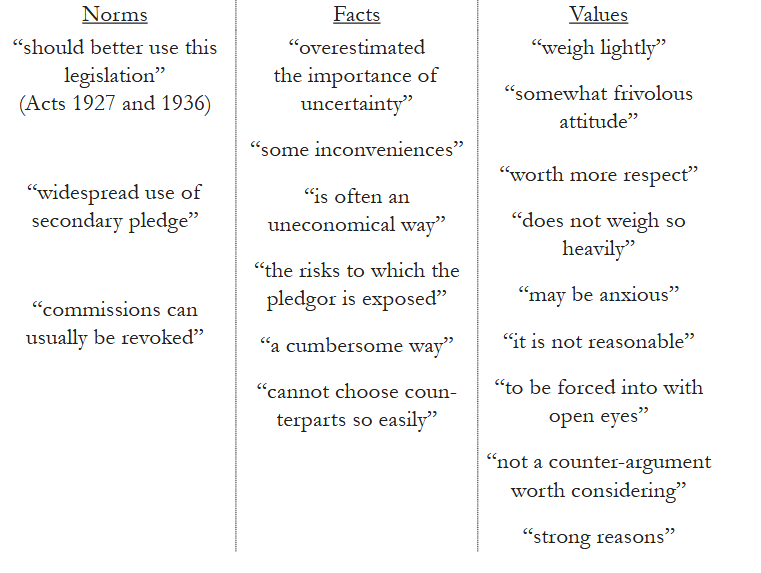
Note: It can here be noted that the assessments I have made when classifying the arguments can be discussed. There are some difficulties in classifying in a way that everyone can agree on9Compare however “As long as it is unclear what we understand by facts, norms and values, such methodological discussions are prone to end in ambiguities, vagueness and confusion […]”, J. Hage, “Facts, values and norms”, in S. Taekema, B. van Klink and W. De Been (eds.), Facts and Norms in Law. Interdisciplinary Reflections on Legal Method, Edward Elgar Publishing, 2016. Several of the contributors of this anthology points at the complexity in the relation between norms, facts and values, and also the difficulties in se them as separate. See also for example H. Hyden and M. Svensson, “The Concept of Norms in Sociology of Law, Scandinavian Studies in Law”, Law and Society, vol. 53, 2008, p.15-31.. One difficulty is for example that some arguments have more than one side; they can be seen as norm and fact, and even as value. It is however not of decisive importance that everyone makes the same assessments. The different effects of the method come primarily from the reflections concerning the arguments. By giving each argument a role in the overall argumentation, the analyst will get a useful picture. It is possible to problematise the classification to the extent that the process does not lead to the intended understanding of the argumentation, but the analyst has then probably turned the method into a theoretical exercise instead of having the ambition to analyse the argumentation at hand. The classification can rather be thought of as assessing the arguments of the argumentation at hand in relation to each other10Compare the “pragmatic solution” and the “petrified crabs” of M. Del Mar, “Relational Jurisprudence, Vulnerability between Fact and Value”, Law and Method, 2012, p.63-81, also with references to other similar choices. M. Del Mar, “The natural and the normative: The distinction, not the dichotomy, between facts and values in a broader context”, in S. Taekema, B. van Klink and W. De Been (eds.), Facts and Norms in Law. Interdisciplinary Reflections on Legal Method, Edward Elgar Publishing, 2016, p.224-241..
The overview that this categorisation gives can, as mentioned, be used in several different ways. In the following sub-sections I give three examples.
A. Evaluation of the facts
Looking at the overview, a relevant reflection has to do with what is indicated by the assumptions on facts. The six assumptions on facts does not necessarily seem to be thought through. They might appear reasonable for someone who know as little as a lawyer typically do about the real world behind, but they might also make up a rather distorted version. By going through the arguments of facts this picture can be seen in a clearer way, and it can also be put into question.
To what extent is it for example, correct that – the debtors in question, can not choose counterparts so easily? – This argument is a classical argument. It can be supported by several portraits in literature of debtors who have gotten into trouble. Lawyers also know about these phenomena through legislation and cases. The conception of the debtor as the weaker market actor is probably as relevant today, as it was through history. But, at the same time, the society of today have been pictured as a credit society11See for example D. Burton, Credit and Consumer Society, Routledge, 2007. Överskuldsättning i kreditsamhället? [traduction: Le surendettement dans la société du crédit ?] SOU (Swedish Governmental Inquiries) 2013:78. And an early example D. Caplovitz, “Consumer Credit in the Affluent Society”, 33 Law and Contemporary Problems, 1968, p.641-655.. That is, a society where credit is the common way of financing different choices and activities. This development might have made the classical conception less relevant.
Another reason to evaluate the argument of the possibilities to choose, isthat the debtors in question have certain characteristics. They are Sellers using their receivables as credit security. It can be questioned if they really have few alternatives when they choose between Financiers?
I would not like to claim that the argument from the prominent lawyer is incorrect. What I want to illustrate is just that the method can be helpful in the way described. The method can make it easier to identify arguments that it can be relevant to look into further.
There are several reasons behind the weaknesses that can be found in lawyers’ assumptions on facts, and the picture of reality lawyers paint. One such reason is a phenomenon called the lawyer made reality12H. P. Graver , Den juristskapte virkelighet [traduction: La réalité créée par les avocats], Tano, Oslo, 1986.. This is a set of claimed “facts” that lawyers have come to have a kind of mutual understanding of. The effect occurs since lawyers are trained to identify what has been said earlier on an issue or a context13Which could be described as fiction, or artificial reason. Compare R. Herdy, “The epistemic dependence of judicial decision-makers”, in S. Taekema, B. van Klink and W. De Been (eds.), Facts and Norms in Law. Interdisciplinary Reflections on Legal Method, Edward Elgar Publishing, 2016 p.84. In the same anthology P. cserne, “Facts and norms in the behavioural assumptions of law”, p.109. C. Fried, “The Artificial Reason of the Law or: What Lawyers Know”, 60 Texas Law Review 35, 1981, p.35-58.. Because of this dogmatic approach also to facts, lawyers sometimes share a picture of reality that only they have among them. It can be a picture of reality stemming from even as early as the Roman lawyers, and thus from societies that had quite different circumstances then ours.
In the case of the example used here this can be illustrated with the third argument on the list in the illustration, that is the argument about “often an uneconomical way”. This argument is a conception on the effects of selling a claim, compared to collecting the debt from the debtor. The assumption of fact might still be correct but knowing the dogmatic sources in the field at hand, it is easy to see that the argument has been repeated in legal texts through the years. It stems from earlier times, and it has, inter alia, been used fifty years ago to legitimise why a particular piece of legislation has the rules that it has14The Swedish act Utsökningsbalken (1981:774) chapter 9 article 11-13.. The assumption of fact thereby shows the characteristics of a fact that is true for dogmatic reasons, rather than that it is the reality. It is however not that evident that the assumption is a correct assumption to do in our times.
To give an example that shows many characteristics of a lawyer made reality I can point at what might, in some cases, be behind the worries of the Seller, who does not trust the Financier. At the point in time when the Seller entered into the contract with the Financier, the Seller might have trusted the Financier because the impression of the wealth of the Financier. This impression thereafter turned out to be incorrect, since lot of the assets that the Financier seemed to have, were sold, or pawned, at an earlier point in time. The creditor gave the impression by having “false wealth”. For those who know this argument false wealth is a general phenomenon, for all kinds of party relations. It is an argument used to legitimise the norms that give inter alia buyers of things incentive to take possession of what they buy. Lawyers learn this argument since they have to understand, and often also legitimise, some norms that gives such incentives. The false wealth example is an evident example since it over time seem to have had different standings in similar societies. It seems, for example, that it has different standings the British and the Scandinavian societies, which, concerning these economical aspects, seem to be rather similar15The false wealth conception is a research question on its own, but compare, for example, the rather different conceptions of the two law commissions of England and Sweden. The Law Commission, Registration of security interests: Company charges and Property other than Land, London, Consultation Paper No 164, 2002 1-3, and SOU (Swedish Governmental Inquiries) 2015:18, p.124..
B. Identifying missing arguments
Another reflection that the method can cause, concerns what arguments that might be missing. When the arguments are assessed and categorised as above the overview can make it easier to see possible tendencies or patterns. This might in turn be useful in attempts to come up with more arguments.
In these attempts it might sometimes be easy to see possibilities by associating from the arguments used. One such argument is in this case that “commissions can usually be revoked”, that is the third argument on the list of norms in the illustration. Thinking of the relationship in such a way could bring the thought of another norm from that area. It could be a norm expressed in the legislation concerning commissions, like this one: Has someone received a power to do and act for another and does the one who gave this power take damage therefrom, then blame himself who did not foresee better. This normative argument need not be seen as more than remotely relevant, since the setting is such that the damage has not yet occurred, but it is an argument that can be compared to some of the value-based arguments on the list.
Another type of argument that is missing is also an argument that concerns the foresight of the parties involved. The overview of the arguments shows no arguments on how the parties can prevent trouble. There are no arguments concerning how the market can solve the issue, by constructing contractual terms. The reason might be that the Seller is assumed to cancel the contract with the Financier in a situation like this, but that is not a solid argument. The parties could decide the terms in a way that they strike such a balance that a cancellation will not happen. There seem to be several solutions that the parties could create to strike such a balance, inter alia by involving an appointed third party. The solution could be combined with damages for incurring costs when the Seller uses such a solution without a valid reason. If such arguments are added, they can be used also for the cases where the parties did not foresee the problem and therefore did not use a contractual solution. For those cases an additional argument can be that the solution of a judge should be such that the parties are given incentives to use a contractual solution.
There is also an entire type of arguments missing that is not unusual to find. It can be found both in the argumentation of researchers and practitioners, including not the least judges. This type of argument concerns solutions in other jurisdictions and in model laws. Depending on the circumstances these arguments might be given rather much weight. For the example at hand this might be so since the involved parties might be from different jurisdictions, and it could seem remarkable if a lawyer, on an issue where there is no clear solution, deviated from a solution that is the common solution in other jurisdictions.
C. Assessment of the character of the argumentation
The categorisation of the arguments in norms, facts and values, gives an overview over all arguments. This overview can be used to reflect upon the character of the argumentation as a whole. A simple way of doing this is to notice that there are (in the overview above) 3 normative arguments, 6 arguments from facts (assumptions), and 9 value based arguments. If these numbers suggest anything at all, it might be that the argumentation to some extent relies on value-based arguments.
This overall picture might be useful for a lawyer dealing with the argumentation. The lawyer might find that the reason that the argumentation at first appeared to be convincing, is that the author is skilled in appealing to the readers value base, such as the readers sense of justice for weaker parties in general.
An overview like this might help the reader to understand the argumentation in a way where this appeal might be assessed in a more self-conscious way, rather than through just a read-through of the text. However, counting arguments is, of course, not a method that in itself is an assessment concerning an argumentation. The overview of the types of arguments is just a tool. What this tool can be used for needs to be reflected upon against the specific context.
VII. Cross-disciplinary possibilities
A possible effect of the analysis that I have described in the sections above, is an increased interest in other sciences. As described, a legal researcher who can identify the role of facts can find it relevant to investigate the facts. The investigation can be done in the way the researcher finds best. In issues like the example at hand, cross-disciplinary studies cross-disciplinary cooperation could be useful16Compare J. Hage, “Facts, values and norms”, in S. Taekema, B. van Klink and W. De Been (eds.), Facts and Norms in Law. Interdisciplinary Reflections on Legal Method, Edward Elgar Publishing, 2016. In the same anthology: P. Cserne, “Facts and norms in the behavioural assumptions of law”, p.105-106..
The understanding that the lawyer gets from the perspective of the theory of law as norms, facts, and values, can solve some of the difficulties that lawyers have in cross-disciplinary work. What the lawyers need to do to, get further from the assumptions of facts that lawyers have made is, sometimes not much. Even a simple understanding of another discipline can then lead forward.
In the example used above a cross-disciplinary effort could be to investigate what has been mentioned on frequency, size of claims, known number of cases of distrust, etc, could be investigated. This does not necessarily need a cross-disciplinary effort, but an interest in the methods for doing this kind of investigation can be useful.
In cases where a more thorough understanding is needed the legal researcher might better use cross-disciplinary cooperation, and in such cases the understanding of how law can be seen as a symbiosis of norms, facts, and values, can be helpful. The legal researcher can for example use this understanding to find his or her role in cross-disciplinary cooperation. In such cooperation legal researchers are reported to have problems17See for example I. J. Kroeze, “Legal Research Methodology and the Dream of Interdisciplinarity”, Potchefstroom Electronic Law Journal/Potchefstroomse Elektroniese Regsblad, 2013, (16)3, p.36-65. W. van Der Burg, “The need for audacious, fully armed scholars: Concluding reflections”, in S. Taekema, B. van Klink and W. De Been (eds.), Facts and Norms in Law. Interdisciplinary Reflections on Legal Method, Edward Elgar Publishing, 2016, p.265-286.. They, inter alia, tend to get the role of telling the others what the law is. The others want to know what the law is to use that information as a given. This can leave the legal researcher out of the actual research in the project, more or less. The legal researcher does not influence what the research question is, nor the method or the process to reach the result. When the legal researcher instead can point out that the law is based on a specific assumption of fact and, that it is relevant to know the reliability of that assumption of fact, chances increase that there can be a fruitful understanding between the researchers.
To give an example also of a case where cross-disciplinary cooperation can be especially useful, I can point at two studies concerning the principle of traditio18J. Andreasson, W. Faber, Shubashis Ganggopadhyay, C. Martinson and S. SJögren, Prioritet för köpare — en fråga om tradition eller princip? [traduction: Priorité aux acheteurs – une question de tradition ou de principe ?], Svensk Juristtidning, 2015 p.709-748. J. Andreasson, W. Faber, S. Ganggopadhyay, C. Martinson and S. SJögren, “Efficient priority rules under default: the case of traditio versus contract principle”, European Journal of Law and Economics, 51(1), 2021, p.97-128.. Both these studies needed to deal with assumptions of facts made by lawyers, and the entire set of these assumptions where such that they had established a lawyer made reality19See above concerning H. P. Graver, Den juristskapte virkelighet [traduction: La réalité créée par les avocats], Tano, Oslo, 1986.. This was the case since it, in many jurisdictions had been necessary to legitimize the choice of principle; traditio or contract. Lawyers had been dealing with the question if the principle of traditio is less or more efficient than the alternatives, but to a very high degree only within the dogmatic context. The issue was a rather big issue for the choice of principle in the DCFR-study.
There were also two propositions to change principle in one jurisdiction, the Swedish. My colleagues and I, three lawyers and two finance economists, did two cross-disciplinary studies on the matter. We could show i) that there was indeed a rather distorted lawyer made reality involved in most of the legal argumentation that we analysed, ii) that there is no distinct difference between the two principles when it comes to efficiency. By “show”, I mean that we have moved the research front on the issue. What we showed sets, in principle, a new standard where the issue needs to be treated as an issue concerning “priority for buyers”; which is the real issue. It is however another matter if lawyers and legal researchers will notice, since legal research is dogmatic, and national, to such an extent that most lawyers will not take notice of the research front.
VIII. Constructive method
From what has been mentioned in the sections above it is but a short step to take for anyone who likes to use the theory for constructive purposes. Several constructive elements have already been mentioned. The analysis of a legal argumentation can lead to different ideas on how to improve the argumentation. It is therefore of course also possible to use the theory for different ways of constructing new content on new research questions, that no one else investigated before.
Compared to the description of the method for analysis, a constructive approach can be achieved by turning the analytical tool around. Instead of starting with a legal argumentation, it means starting with identifying a question of law.
The next step is to formulate this question as a question, that by being answered, can be turned into a norm, a rule. After that the process can simply be to identify and construct relevant arguments by using the perspectives norm-facts-values. By reflecting upon these different aspects of the legal issue the arguments, and maybe especially the assumptions on facts, can become a list. Looking at the list the weight of each assumption of fact can be considered in a conscious way. This can improve the way the issue is handled; both in legal research and in practice.
The method can be illustrated as below. As seen the question of law is a question concerning the duties of debtors in general. Should a debtor be obliged to provide information about his debt to speculators and acquirers ?
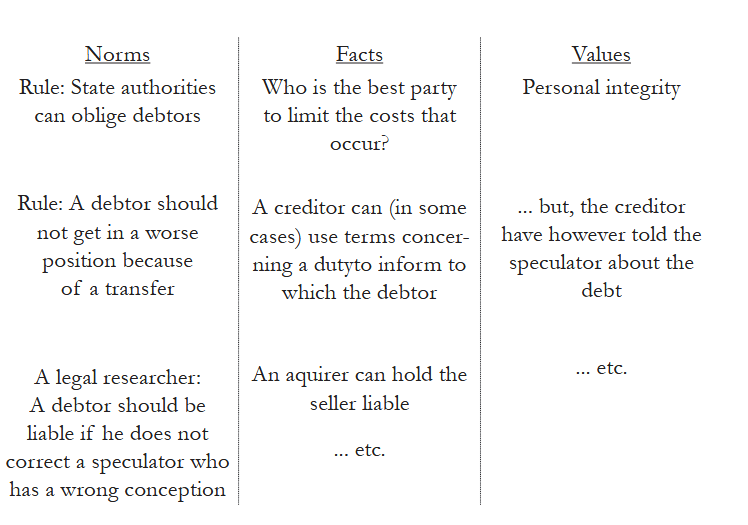
Since the issue is dealt with in different ways in different jurisdictions, not all readers will agree that the arguments fit the respective context of their jurisdiction. Hopefully the reader can anyway use the illustration from the assumption that there, in the jurisdiction of the illustration, is no other regulation, or system, than what is mentioned in the illustration. At least the question of law should, as far as my experiences goes, be a question that does not have an evident answer in most jurisdictions, hence my choice of this question.
Note that the question at hand is a question that is constructed in a way that it could easily be turned into a norm. It starts with a “should” and contains requisites. If answered with a “yes”, the norm becomes: A debtor is obliged to provide information about his debt to speculators and acquirers of the claim against the debtor. Since this becomes a rather broad norm, it might be necessary to add restraining factors to the question, or the norm, such as – if the debtor is compensated for the costs for providing the information, or, if the debtor does not thereby reveal integrity sensitive information about himself.
IX. And back to the theory
What I have explained in the sections on the example above, is how the theory in question can be used to create different methods. The methods can mainly be used for analysing legal argumentation and for constructing legal argumentation. In this last section of the article, it is relevant to point out that I, by explaining this, have indirectly put forward support for the theory. I have indirectly showed support for the claim that lawyers use not only norms, but also what can be seen as facts and values. One thing that I have illustrated is that some lawyers do this rather openly. They reveal some of their understanding the context they deal with. A reason for this can be that they need to legitimise the standing they argue for. What I have not shown clear support for is the claim that lawyers use facts and values also without making it evident to themselves. The claim is that lawyers make assumptions on facts both consciously and subconsciously, without necessarily thinking their assumptions through. This includes that they also use their values in what they interpret. It is my experience that lawyers do this, and I have many times seen that revealed in oral discussions. I have however not here shown support for this claim, and therefore leave that to the experience of the reader. Nevertheless, my claim is still that it, also in these subconscious cases, is relevant to think in terms of a relationship between norms and facts, as well as between norms and values.
Looking at what I have showed it is possible to claim that there is indeed support for acknowledging a relationship between norms and facts, as well as between norms and values20Compare the contributions in S. Taekema, B. van Klink and W. De Been (eds.), Facts and Norms in Law. Interdisciplinary Reflections on Legal Method, Edward Elgar Publishing, 2016. Compare also F. Rouvière, “Existe-t-il un concept juridique de fait?”, in Cahiers de méthodologie juridique 2022-3, p.1397-1414. C. Aubry De Maromont, “Et si le questionnement des rapports entre les faits et le droit révélait les écueils de la production scientifique dans la discipline juridique?”, in Cahiers de méthodologie juridique 2022-3, p.1379-1396.. Law can be understood as norms, facts, and values. There might even be reason to claim that legal research can gain from developing the understanding of this relationship, since it can be seen as an unavoidable part of what law and legal activity is.
Although I think the theory is of fundamental importance for what I have explained, I like to end with pointing out that the main point of what I have presented is how the theory can be used. It can be used to construct methods for legal analysis in both legal research and practice, and for constructing legal reasoning. Hopefully, the readers can find some use of these thoughts and make something out of them that fits for their understanding and their preferences21An example W. Faber, M. Lilja (and G. Kreuzbauer), “Employing Argumentation Analysis in the Discussion of Optimal Rules for the Transfer of Movables – Part 1: Description of the Problem and General Outline”, European Property Law Journal, 1(1), 2012, p.10-53. W. Faber (and M. Lilja), “Employing Argumentation Analysis in the Discussion of Optimal Rules for the Transfer of Movables – Part 2: Examples and Conclusions”, European Property Law Journal,1(2), 2012, p.232- 298. See also my study C. Martinson, Femton förmögenhetsrättsliga forskningsresultat [traduction: Fifteen Research Results in Property Law], Iustus, 2018..